Mobile App
Building accountability for shared homes without one roommate playing enforcer.
Role
Product Management
Product Design
UX Research
iOS & Android Development
Company
Karomi Studio
Device
Overview
Dotted started as a chore tracker for my own house and became a governance app for shared living. Roommates put their house rules in a signed agreement, change them by vote, and split chores and bills with a fairness record the system keeps. I own the product end to end.
Problem
Chore apps solve remembering. The chore that breaks a house is not the one someone forgot, it is the one someone skipped. When that happens, every app in the category has the same answer: another notification. The conflict moves to the group chat, or to whoever is most bothered, who does it themselves and starts keeping score.
Solution
Treat shared living as a governance problem instead of a scheduling problem. Rules are written and signed. Changing one takes a vote. Chores have legitimate ways to move when life happens, and every obligation keeps a name on it. Fairness is a number the system computes, not an argument someone has to start.
Everyone stands on the same footing. The only elevated role belongs to whoever created the home, and even they can't change a rule without the house voting.
Status
Live on Google Play and the App Store since summer 2026. Too early for usage claims, so none are made here. The measurement plan was written before launch and is running now.
Where it started
The first version was a recurring chore tracker for my own house. It worked until someone skipped a turn, and then it had nothing to offer except a red badge. When I studied the market, it split two ways. Family chore apps run on hierarchy: a parent assigns, a child completes, points become allowance. Roommate apps are reminder lists with streaks. Nothing served a house of equals, where no one has authority over anyone else and no one wants it. In my house, nobody was forgetting, and nobody was anyone's parent.
The hard part of shared living was never remembering the trash. It's what happens when someone doesn't take it out.
What the research changed
I went to the family-communication literature to check whether that held beyond my own house. It does, and the field has a name for it. Threshold theory (Alberts, Tracy, and Trethewey, 2011) says people carry different tolerance levels for undone tasks. Whoever has the lower threshold hits it first and does the work, every time. The same paper ranks chore disputes “amongst the most common and destructive” sources of relational conflict. A 2012 follow-up extended this to roommates: mismatched thresholds erode the sense of fairness over time. So unequal chores are not a scheduling failure. They are a structural outcome, and no notification fixes structure.
Two more findings shaped the product. Universities from Elon to Purdue require roommates to write and sign agreements, on the logic that expectations set early prevent conflict later. That validated the signed agreement and seeded Dotted's default rules. And a semester-long study of leaderboards and badges (Hanus and Fox, 2015) found the gamified group ended up less motivated and less satisfied than the control. That is why Dotted has no leaderboard.
Key decisions
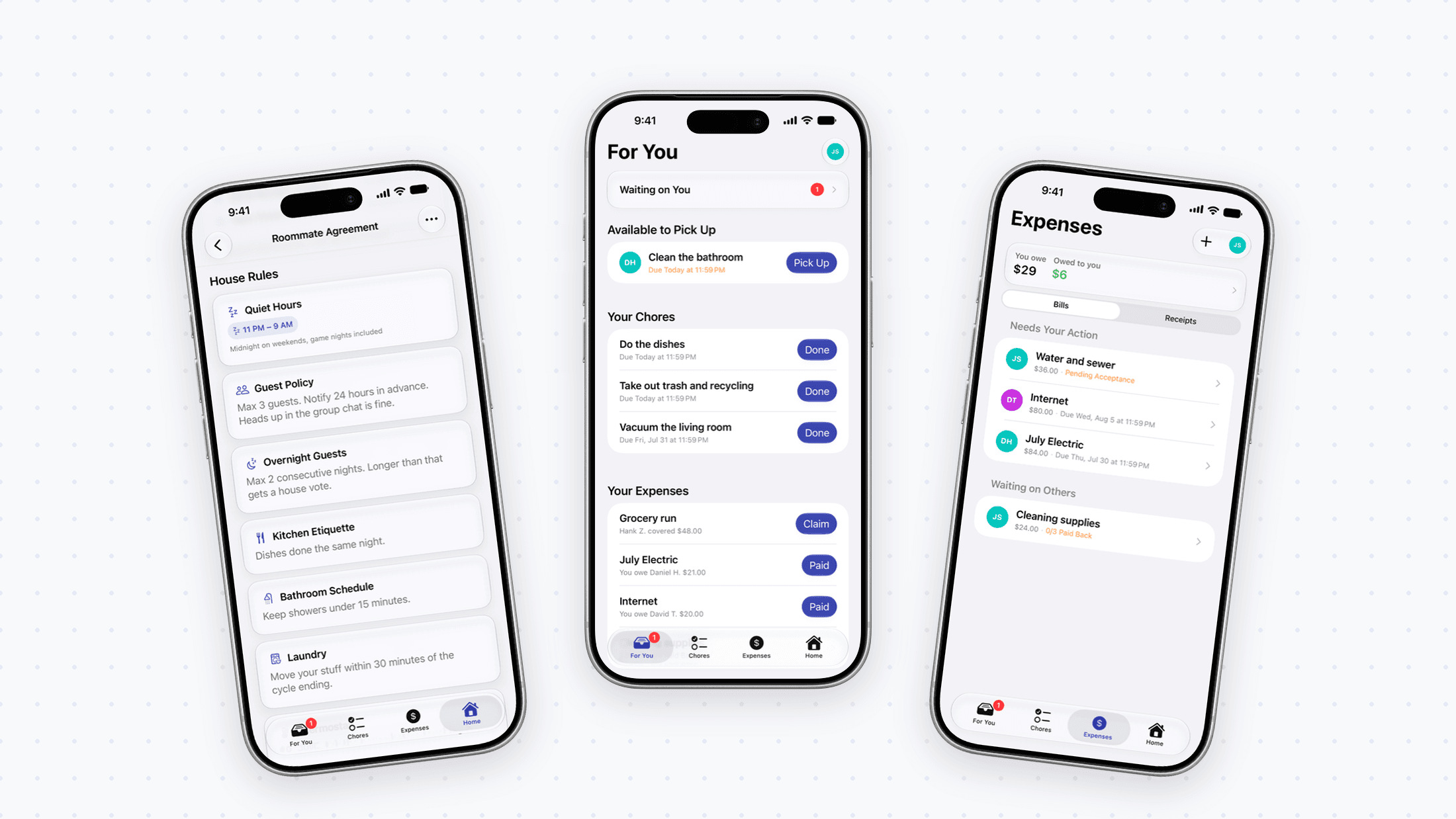
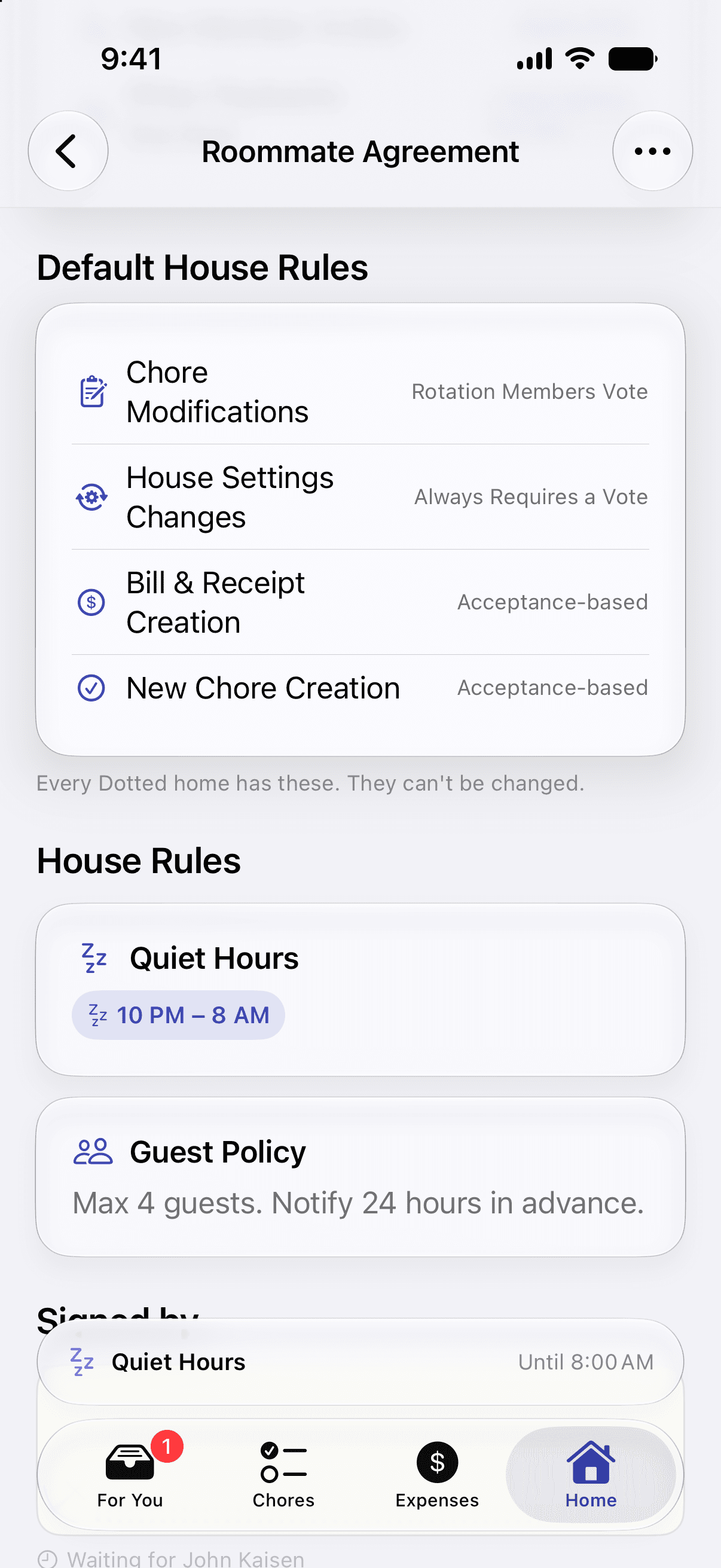
The agreement. Quiet hours, guests, dishes: each house writes its rules before they are a problem, and everyone signs with their finger on the dotted line. Changing a rule is a proposal and a vote, never an admin edit. The signature is a commitment, not a contract, and that is on purpose.
Passing is free. Pass a chore with a reason and it opens to the house; honesty has to cost less than going silently overdue. Rescuing someone else's chore earns more than doing your own, and a housemate confirms each completion, because nothing counts on your word alone.
Dotted never holds money. Snap a receipt and it reads right on the phone; split it item by item or let everyone claim their own share. Settling up opens Venmo or Cash App with the amount filled in. Dotted keeps the record; money moves where people already move it.
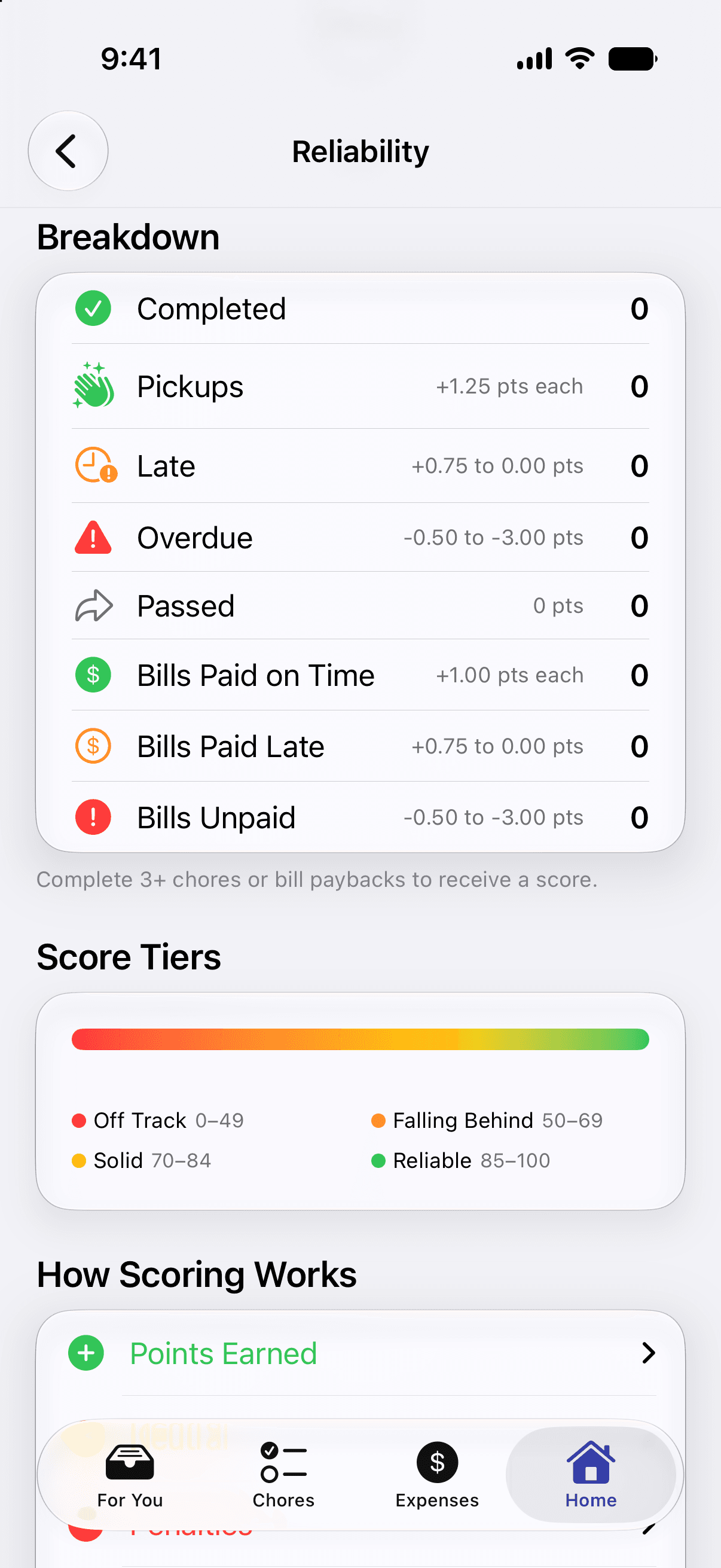
Standings, not a leaderboard. Written as a principle before any scoring existed: Dotted should not treat chores like an arcade game. One score per roommate, built from what each person was actually responsible for, with the why visible behind the number. Widgets keep today's chores and who-owes-whom on the home screen, because the group chat is one glance away.

Iteration
The product went through fourteen self-run audit passes plus informal testing with my housemates and TestFlight testers. The revisions that mattered:
Passing used to cost points, which punished the honest and rewarded the silent. The penalty is gone. Being an hour late used to count the same as being a week late; now lateness fades your credit gradually, with more grace for chores that come around less often. A single nudge used to open someone's chore for pickup, which let one roommate profit off one vote; now it takes the whole house. And the standings tiers used to carry labels like “Needs Work.” An app your roommates share should not call anyone lazy, so the labels describe standing now, not character.
What I'll measure
The funnel that matters is social. One user alone is a failed install, so the questions are whether the approval step kills joins, whether a solo creator ever invites anyone, and whether the delayed notification ask earns a yes. Retention reads separately for creators and joiners; their first weeks look nothing alike.
The governance mechanics get their own checks: if passes go unused, people are failing silently; if confirmations stall, honesty costs too much; if no rule is ever proposed after week one, the agreement is a formality. Analytics are first-party and disclosed at sign-in, with no cross-app tracking.